
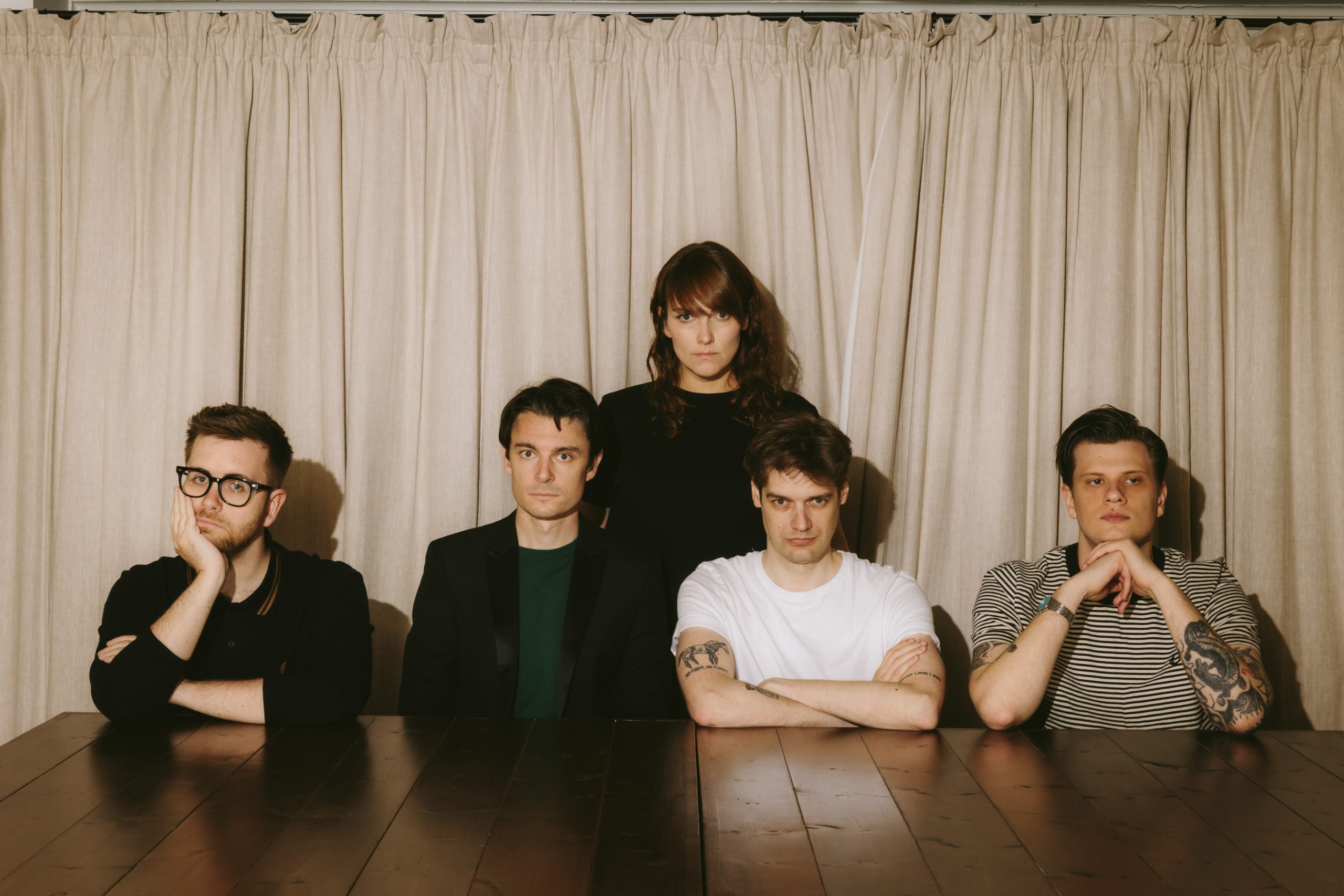
Ahead of Pit Pony‘s second album Dead Stars set for release on 7 February via Clue Records and EMI North, The Decibel Decoder spoke to Jackie Purver (vocals), Andrew Jones (guitar) and Garth Purver (guitar). The conversation included an explanation of the democratic process employed for track selection for the album, the difference in producing the second album in comparison to their debut, the importance of independent venues to Pit Pony, but perhaps most importantly, who did have Deliveroo on speed dial.
What was the main difference between producing and recording Dead Stars compared to your debut World To Me?
Andrew: I guess the first thing is we had more time, both for writing and recording so we could be a bit more considered about details and what songs we wanted to use and the areas we’re exploring. And it meant we were allowed to be a lot more collaborative with everything as well. In terms of the actual recording, with the first album we set up as though we’d be playing a live gig, doing the vocals over the top. This time we were able to hone in on each individual element; how we did the drums, the simple separation to the overdubs and the different parts. I think it meant we were a lot more detailed focus, which allowed us to, I think, make a more cohesive sound.
And where did the title of the album come from? Dead Stars is quite dramatic.
Jackie: We always struggle to think of a title. So one of the songs was called ‘Dead Stars‘. And the title for the song is basically about how we’re all made of dead stars. And it’s about the fact that the light you see from a lot of stars is actually stars that are dead, but they still have an impact on things around them. So I just thought it was quite a nice concept of the impact that you have on people around you and in the future, even when you’re not around anymore.
We did that for the first album as well, we tend to go around in circles of what we’re going to call it! And because there’s five of us, you’ll think, “Oh this is a really good idea“. And then someone else is like, “No, I’m not calling it that!”. There’s a lot of ideas, but we’ll usually settle on a song title.
Andrew: I think, as well, it puts a bow on top of all the themes that the album explores. I think that as the last track, like Jackie said, it’s sort of what is left after you’ve gone. But then also the fact that we’re all made from the same substance.
Jackie: It’s a nice one to name it after because it bookends opener ‘At Dawn’. The riff from ‘Dead Stars’ is played (on ‘At Dawn’), and it’s the last song on the album as well so that kind of pulls it together. We thought it fitted for that full circle moment.
There’s 10 tracks on the album and I was wondering when recorded it were you set on those 10 tracks? Or did you have a bundle of songs you were still deliberating on?
Andrew: From what I recall, we had two additional tracks, ‘Fuzzy’ and ‘Accidental Doom’, which we decided to do as singles before, but not include them on the album. But I don’t know if you guys can remember how we came to that decision.
Jackie: We had a voting process. We had two or three extra songs and we each voted. We had a point system, like Eurovision!
Garth: I did a Google Form!
Jackie: It was basically like Eurovision! We could award each song so many points. There’s one song called ‘Love of Mine’, which nearly didn’t make it, but because it was my favourite, and I knew others didn’t like it as much so I scored that highest! So it was a bit political, but I think got a good balance in the end.
Garth: I think we maybe ended up with 15 that were fully finished. Yeah, then we did the voting system, which whittled it down. I think we were then, we’ll record 12. ‘Accidental Doom’ and ‘Fuzzy’ had been around a little bit longer, and it felt like they sat in the middle of the two albums. They weren’t as fresh as the 10 that have ended up on Dead Stars, they felt like a bit of a bridge between the two.
And there is 5 of you negotiating these decisions.
Jackie: We all have really different tastes as well, but that’s what makes the songs what they are, because everybody brings their own part to it.
Andrew: It’s definitely one of our strengths as a band, that we allow ourselves to pull from different influences. We don’t shoot each other down. We can try something out and see how it works. And it’s a lot of fun. I love writing for this band!
Jackie: And Garth and I are married so we’ll be arguing and the others will just stand around awkwardly!
Garth: At least because there is five of us, when things get put to a vote, it’s never a dead heat. It’s a clear democracy!
‘At Dawn’ is the opening track on the album. It has such a shifting vibe throughout, with it’s energised start but then a short section where the vocal has almost a folk influence to it.
Andrew: It was one of Andrew (Potter, bass) ideas. It’s funny you mentioned that, because it started out as a folk song. He wrote the main part on an acoustic guitar, and he was trying to teach us it, and I couldn’t play it because I had an injury, and the way he played it, it just didn’t work. Then we swapped roles, and it formed from there. Him and Joey (Morley, drums) have similar influences and it’s really interesting how that song formed.
It also has the guitar section on the outro and you were saying that that ties in with the riff in final track ‘Dead Stars‘?
Jackie: That’s the ‘Dead Stars’ riff. Obviously people are not going to notice it straight away, because it’s at the very end but hopefully people will loop it and then eventually pick up on it.
Andrew: It’s a nice accident because we realized it’s in the same key. We were messing around because Andrew originally had that outro in mind when he was messing around with it. I think as a joke he started going into the ‘Dead Stars’ riff from it and it was a moment when everyne thought “Yes!”
Throughout the album there is different sounds and paces. ‘No Shame’ has an almost an Eastern twang to it, whereas ‘Waves’ is much calmer more ethereal and ‘Vacancy’ has a punky energy. Was that fun pulling together these different soundscapes?
Jackie: The first time we were more sort of garagey and the songs probably tied together a little bit more in that vein. And this time, because we had longer, we were like, “right, there’s no format”. We just came up with ideas, and we’ll just see where they go. And so it was really natural that they turned out the way they did. We didn’t want to deliberately say “oh, that doesn’t sound like us. That’s not heavy enough.” So we hoped they would tie together, because it was us and people would find the links. It was nice to be able to progress a little bit and do things a little bit differently for album two, because it’s more enjoyable, isn’t it, to try something a little bit different.
Garth: Like all the artists we like ourselves, we want to evolve from record to record. It has to progress from the first one. You want to push yourself in terms of what you do. This time there were different elements going on that maybe you don’t necessarily get if five people are playing together in the studio. We spent quite a bit more time factoring in the different elements and thinking more about maybe the way it sounds.
Andrew: For me, it was a lot of what can I do to elevate this song, rather than, what can I do to just play it. Like you said about ‘No Shame’ I really like surf music, so you might have a bit of that Eastern influence, but then with ‘Waves‘ I like film soundtracks, so what kind of textural and atmospheric stuff can I add. And I think everyone’s doing their own version of that. And because we had that time in the studio, it allowed us to sort of bring it together in a more cohesive way. It was a great process to be part of.
Was it more enjoyable this time around from all the things you’ve been highlighting, or is it just too difficult to compare because that was your debut album?
Andrew: I certainly enjoyed it a lot more. And I think particularly the equipment we used, and the rigs we had, and it would be a lot more of like, “Garth, why don’t you use my guitar for this one that sounds really good”. Or he would do it for us, or using pedals and different amps. It was really fun to geek out with all the gear and stuff.
Jackie: I think for the guitarists is was great. Joey the drummer did his stuff in two days, and then he was done, and all he did was order Deliveroo. And I did most of my vocals afterwards because if there’s things that you can get done quicker with one person in a booth, then you want to spend the time sat with the different textures on top. It was just nice to have the time together, wasn’t it? And have a bit more time to think about it and add in all those layers. With ‘At Dawn‘ I did my vocal for those bits that you were talking about, and then I was in the studio that night doing some other backing. We thought why don’t we just try having a male voice with that as well, because it’ll just give it an extra layer. And at the end of ‘Something in the Water’, you all got to do a bit of singing as well, didn’t you? It’s just time to really listen to it and say, actually, can we just try that? And if it doesn’t work, it doesn’t work. But when you’ve only got a week, and you’re trying to rush it and play it all live and everyone get it right at the same time, you just don’t have that kind of freedom. But if you’d given us a month, we probably would have never stopped!
Garth: We had a Google Doc that was just ideas for every song. It doesn’t matter if it’s a bad idea. You just put it down on the sheet, we’ll do it. And then once it’s done, we’ll decide whether it stays or it goes. We basically worked through that with Chris (McManus, producer, Blank Studios) in the studio. We didn’t have the luxury of the time to do that the first time around.
Jackie: Chris sees things that we don’t see. So especially with ‘Cut Open’ he added a lot of elements. It’s nice to have other people’s views as well and have them understand the kind of vision you’re going for.
You’re on tour in April and as we speak this is Independent Venue Week. What do independent venues mean to Pit Pony?
Andrew: I mean, they’re our bread and butter but it’s also going back to when we were younger, and the various bands we played in. We wouldn’t be playing in bands and doing music if we didn’t have these opportunities for starting out, when you’re young and playing in front of next to no one, and then maybe you’ll get the opportunity to support someone like a touring band. Unfortunately, a lot more of these venues are going under, or really, really struggling. It’s important that people come together and try support them when they can. And we’re fortunate in Newcastle, there’s a few spaces which are independent, but I know in a lot of cities they’re not so lucky. We’re certainly very grateful for that.
Jackie: And I think it’s not just about becoming famous and becoming mainstream. It’s about grassroots. It’s about kids, teenagers, having opportunities to make music and be creative. That’s why it’s so sad, because being creative isn’t something that should be defined by success. It’s just good for you to do. It makes you feel better. And if we don’t have those small venues, like a 50 cap venue, where a lot of kids can play music, and their friends can turn up, then you’re just cutting out opportunities for people to be creative and learn more about themselves.
Garth: You need those spaces so that anybody at any point can enjoy it. It’s a stepping stone, to use a word that’s been said on 6music a million times this week, its the ecosystem where people can exist in these spaces. And sometimes you go to these venues and you see the same faces. These spaces are a community,
Andrew: I think, as well, particularly in like a city like Newcastle and northern cities, which are often missed out from both funding and the more established mainstream touring acts, people will make their own local scene. You see the same faces, and it becomes more cooperative and collaborative than it is competitive. I love about our city, the music scene.
Jackie: In 2004 I saw Arctic Monkeys downstairs Head of Steam. If it wasn’t for those people being there at the beginning, Arctic Monkeys wouldn’t be the 100 quid a ticket stadium band they are now. So it’s thinking about the perspective of if they didn’t have that opportunity we wouldn’t have these big bands.
What is the best thing about being on tour?
Jackie: It’s meeting people, to be honest. And we’ve met so many people, it’s lovely to go to different venues and see the same people again, and you know about them, and you know they come and support us, and again, it’s that community. They tell us about other bands they’ve seen, and then we’ll get to play with bands that we love, and meet other musicians, and it’s just the whole network. It’s not the long drives in vans! It’s not the travelodges!
For more information on Pit Pony please check their facebook and instagram.