
Trigger Warning.
Themes of sexual violence.
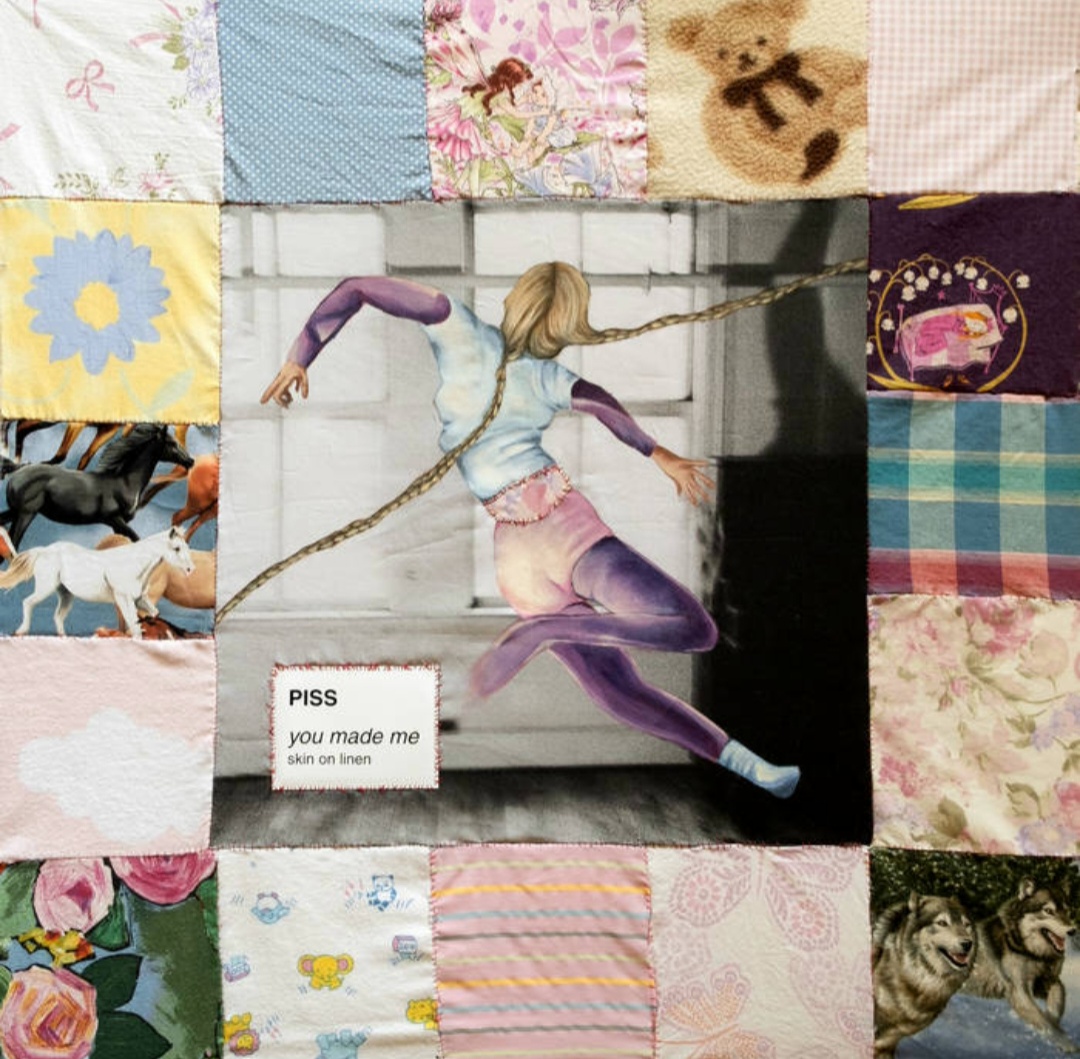
Once in a while a body of work is released which feels important. Challenging, thought-provoking, shocking, informative, uncompromising, therapeutic, cathartic – all these apply to Vancouver band PISS‘s debut album you made me / skin on linen, out now via Paper Bag Records (Canada) and Sub Pop Records (worldwide). Yet none of these adjectives feels enough to describe this extraordinary album. PISS is Taylor Zantingh (vocals), Tyler Paterson (guitar), Gavin Moya (bass), and Garreth Roberts (drums) but others are given a voice here, representing varying ideological beliefs about gender-based violence.
The scene is set with opener ‘kai and friends’ and the spoken hopes and dreams of children, but with an underlying layer of darkness ever present sonically before launching into ‘… i wanted to be a singer’. Initially growing out of the sounds of children it is a visceral outpouring: “I’ve spent my life trying to turn my pain into something beautiful.” Taylor Zantingh, the lead singer and lyricist of the Vancouver-based punk and noise-art band PISS, has stated that her childhood was shaped by intimate and sexual violence. This trauma explodes out of ‘… i wanted to be a singer.’ It provides a context that is ever present throughout the album.
Those we hear from throughout you made me / skin on linen include academic and self-described feminist militant Andrea Dworkin, interviewed in 2002, a few years before her death and two decades before Sarah Everard was raped and strangled by Met Police officer Wayne Couzens. “The law isn’t working” never felt so relevant in that situation, and she is heard on ‘andrea I’ and ‘andrea II’.
‘manon on the trail of gisèle pelicot’ hears from Feminist philosopher Manon Garcia. Gisele Pelicot’s was married to Dominique Pelicot for 50 years, they raised three children, eventually settling in Mazan, France and living a quiet life. Unbeknown to her however, she had been the victim of the most disturbing case of mass-rape over the course of nearly 10 years. After Dominique Pelicot was arrested in September 2020 for ‘upskirting’ women in a local supermarket, a police investigation uncovered more than 20,000 images and videos of an unconscious and drugged Gisele Pelicot being sexually assaulted by 72 different men. The horror of this revelation, as she had no memory of these assaults.
‘toni‘ is a segment of a discussion between author Toni Morrision, who explored trauma, and Mavis Nicholson. Self-forgiveness is possible, she argued, through a state called grace. However, you cannot bypass the pain. A person must first endure a complete descent into deep, raw emotions: “genuine shame, hatred, humiliation, and complete self-loathing – that is the door and if you can get through that then you can forgive yourself”
And ‘vikki’ is by therapeutic supervisor and community activist Vikki Reynolds, who discusses rape and holding men accountable for their actions but also the challenge of educating young men to ensure they do not perpuate such behaviour in a society dominated by the patriarchy.
PISS have used their creativity to process trauma, and this is unleashed in punk, noise and hardcore. ‘time loop at hot slit’ is frenetic punk with screeching guitars and pulsating drums alongside the enraged vocal of Taylor: “some words are bigger than bodies / I never learned how to get them out of my mouth.” And ‘there was a door’, a ferocious hardcore cathartic offloading, the fury unleashed and the lyrics heartbreaking: “After that I lost my sense of self to feel the warmth / After that nothing made sense except to feel the warmth.” Rage ensues on ‘a little girl’s horse craze betrays her’, a girl’s childhood violently taken away, the damage inflicted impossible to erase.
‘blocking a scene you can’t remember’ is brutally powerful, describing an act of violence, building in its intensity. “does your wife know what you did?” The track is interspersed with “cut, again”, emphasising how this trauma manifests itself in the victim. It calms at one point, slowing everything to a near standstill, unfolding as a fragmented rehearsal for a confrontation that is repeatedly interrupted by trauma.
‘Rote Zora. “Resistance is Possible.” Emma, no. 6, June 1984, pp. 39-41.02:55’ transforms a transcript from an archival interview with the German feminist militant group Rote Zora into lyrics for a cacophonous exploration of resistance, agency, and collective action.
Final track ‘i keep trying to change the ending’ provides a contemplative note of hope, of a desire for peace, to live. Attempting to come to terms with trauma and its manifestation is given a shimmering, unpredictable, experimental and at times delicate sonic expression. It is not a linear path, beautifully expressed on ‘i keep trying to change the ending’.
PISS is a band who provide trigger warning at their gigs such is their creativity which is embedded in activism. This album is punctuated with lyrics which tell their own story, shocking in places as they refuse to hide from the truth of their own narrative. PISS blur the line between the personal and political. They are proof that taking back power is possible, through activism, education, community and creativity. A unique debut album.
For more information on PISS please check their instagram and bandcamp.
Review: 9 out of 10